“Pink is for girls, blue is for boys.”
This ‘unspoken rule’ is ingrained in our minds almost like a scientific law. Buying pink clothes for a daughter and blue toys for a son feels completely natural.
But just 100 years ago, the formula was exactly the opposite. There was even a time when pink was considered the color of a “real man.” It’s a dramatic history of gender-color reversal.
1. ~Early 1900s: Gender? What’s that? The Age of White Uniformity
In an era when baby clothes weren’t clearly differentiated by gender, all babies wore white dresses regardless of sex. The reason was simple and practical — white was the easiest to bleach.
In the days before diapers, keeping clothes clean meant boiling and disinfecting them with bleach. White was the perfect solution. “Gender reveal parties” were unimaginable in this gender-indifferent era.
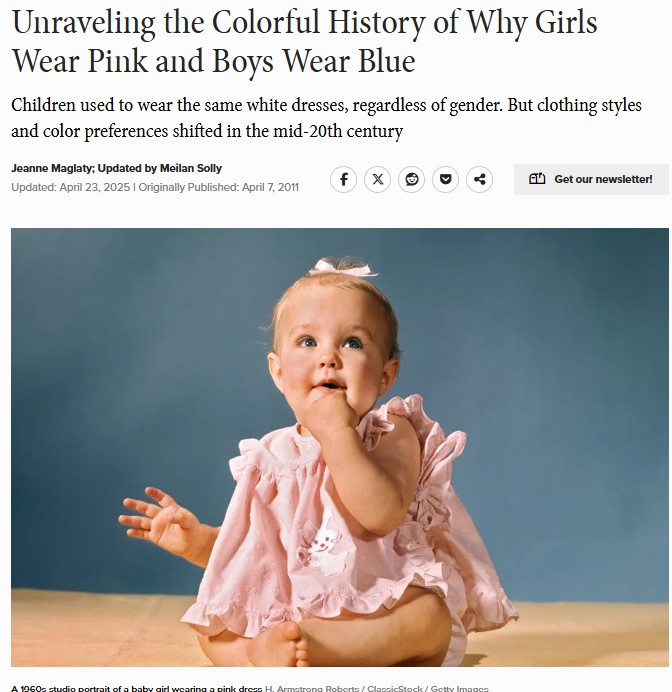
2. 1910s–1920s: Pink for Boys, Blue for Girls!
As baby clothes started to feature colors, an interesting phenomenon appeared — the exact opposite of today’s norms.
In 1918, Earnshaw’s Infants’ Department, a leading U.S. babywear magazine, advised parents:
“The generally accepted rule is pink for boys and blue for girls, because pink is a stronger, more decided color, better suited to a boy, while blue is more delicate and dainty, prettier for a girl.”
The logic was that pink, being a lighter version of red (symbolizing strength and passion), naturally suited active boys. Blue, associated with the Virgin Mary, was seen as a gentle, modest color for girls.
This view was so widespread that a 1927 Time magazine survey found most U.S. department stores recommending pink for boys and blue for girls.
3. 1940s–1950s: The Great Reversal — Pink Becomes the Color of Ladies
So when and why did the “pink = boy” rule flip? Two key reasons:
First, capitalism’s big plan.
After WWII, mass production and consumerism boomed. Companies realized that dividing colors by gender could double sales. If pink was labeled “for girls,” even families with only boys couldn’t hand down clothes — they’d have to buy new ones.
Second, the rise of the ultimate “pink influencer.”
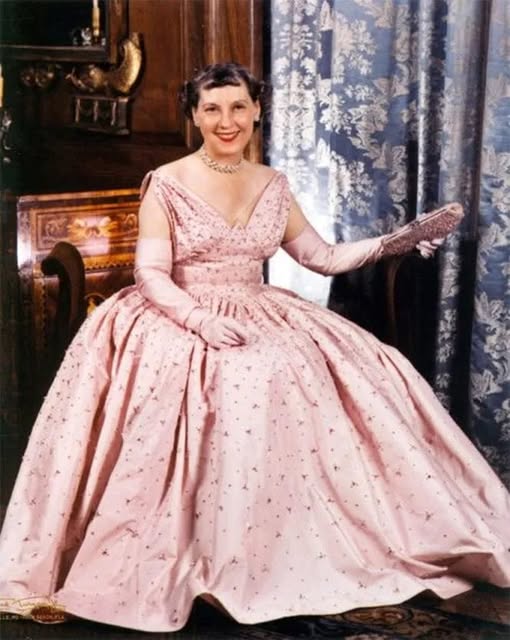
Mamie Eisenhower, wife of U.S. President Dwight Eisenhower (inaugurated 1953), was a pink enthusiast. Her glamorous pink gown at the inauguration ball made headlines worldwide, and she even decorated the White House so extensively in pink it was nicknamed the “Pink Palace.”
As the ultimate First Lady and style icon of her time, her influence cemented pink as a symbol of femininity, elegance, and charm.
In the end, colors were never inherently gendered — they were dressed in gender by culture, history, and sometimes corporate strategy. Who knows? One day, we might again see “tough guys” striding down the street in pink shirts, ties, and even cars.
'English' 카테고리의 다른 글
| The Beginning of Plastic Lies in a Billiard Ball (0) | 2025.08.20 |
|---|---|
| "World Photography Day" – From the Age of Truth to the Age of Creation (1) | 2025.08.19 |
| There Is Only One Bridge Over the Amazon River (1) | 2025.08.17 |
| Bathroom Fashion Item? The ‘Black Toilet Paper’ of Middle Eastern Tycoons… Why It Ultimately Returns to White (0) | 2025.08.16 |
| Palace on the Sea or Carbon Monster (1) | 2025.08.15 |


